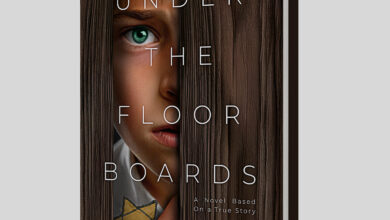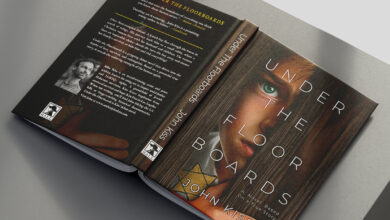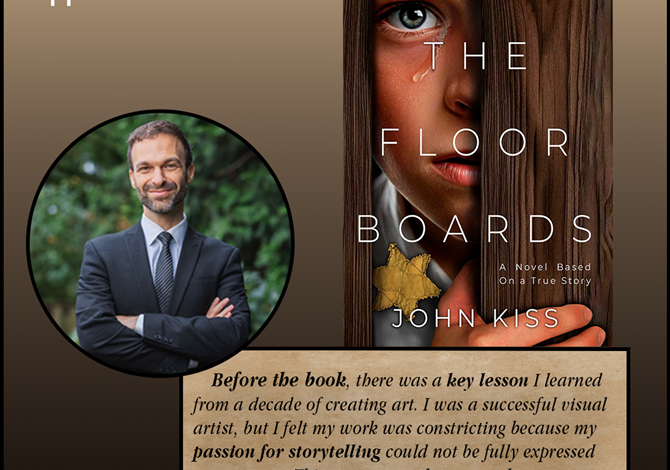
John Kiss is not new to transformation. Known for her bold peace murals and street art that has graced walls from Tel Aviv to Berlin, Kiss (she/her) is now picking up a different tool: the pen. With the release of her debut novel Under the Floorboards, she steps into the literary world with a story that’s both deeply historical and intensely personal.
A peace-promoting graffiti artist turned painter and now novelist, Kiss has always blurred the lines between activism and art. But Under the Floorboards isn’t just a genre leap—it’s a deeply personal reckoning with trauma, identity, and the hidden strength of everyday people, especially women.
The novel is based on the real-life story of Dr. Felix Zandman, a young Jewish boy who survived the Holocaust by hiding for over a year beneath the floorboards of a Christian woman’s home in Nazi-occupied Poland. Kiss first heard the story from her father. “The moment he told me, I was gripped,” she says. “I knew I had to bring it to life.”
While many historical novels invent characters, Under the Floorboards remains firmly rooted in fact. Kiss spent years researching, drawing from survivor testimonies, archives at Yad Vashem, and crucially, conversations with Dr. Zandman’s widow, Ruta. “She helped me understand his trauma, but also their love—the healing that came later. Her role in his story is as vital as his survival,” Kiss explains.
Though grounded in history, the novel is shaped by Kiss’s own lived experiences. “I grew up in Israel during the First Gulf War,” she shares. “I understand what it means to live with trauma—so do many of my friends. Writing this book has been a personal journey of healing.”
Kiss’s method of writing is emotionally immersive. “When I feel myself crying, or tensing up while writing a scene, that’s how I know I’ve found truth,” she says. “This isn’t just about facts—it’s about how it felt to survive, to hide, to love again after so much pain.”
What haunts her most, she says, isn’t the violence—it’s the intimacy of trauma. “The hardest part of the book is not the hiding—it’s the protagonist’s struggle to let himself be loved. That fear of being truly seen, even by family—that broke me. I remember typing with tears on my keyboard.”
The novel took years—written and rewritten, sometimes in long pauses between painting and peace work. But Kiss never abandoned it. “I’ve always believed storytelling is a form of activism,” she says. “If this story can give others the bravery I didn’t have, it will have succeeded.”
Under the Floorboards also challenges long-held assumptions about who gets to be remembered in historical narratives—especially in wartime. In much of popular World War II fiction and film, male heroism dominates. But Kiss, along with authors like Catherine Hokin and Laura Spence-Ash, is part of a growing wave of writers shining a light on the overlooked women of history—those who shaped lives not from the battlefield, but from behind closed doors.
Hokin’s The Train That Took You Away tells the story of Esther Spielman, a mother who risks everything to save her son as the Nazis rise to power. Laura Spence-Ash’s Beyond That, the Sea follows a girl sent away from wartime London, wrestling with identity and belonging. These narratives, like Kiss’s, recenter the female experience—one of quiet endurance, invisible labor, and soul-deep courage.
In Under the Floorboards, the Christian maid who hides Zandman becomes a quiet force of salvation. “Women in this novel don’t shout or fight—they shield, they endure, they save,” Kiss says. “That kind of bravery isn’t always visible, but it’s unforgettable.”
For Kiss, this novel is both a tribute and a turning point. She knows some may still doubt whether a visual artist can make a mark with words. But she isn’t worried.
“I didn’t set out to prove anything,” she says. “I just wanted to tell a story that mattered. I believe in creativity more than categories. And I believe the written word can hold pain, hold beauty—and change hearts.”
Will Under the Floorboards open a new chapter for Kiss, or be remembered as a powerful detour from her work on canvas? Only time—and readers—will tell. But one thing is certain: in every medium she touches, Kiss is telling the stories that demand to be seen.
Author